IPTV vs. Traditional Cable:
Why 2026 is the Year to Switch in Australia
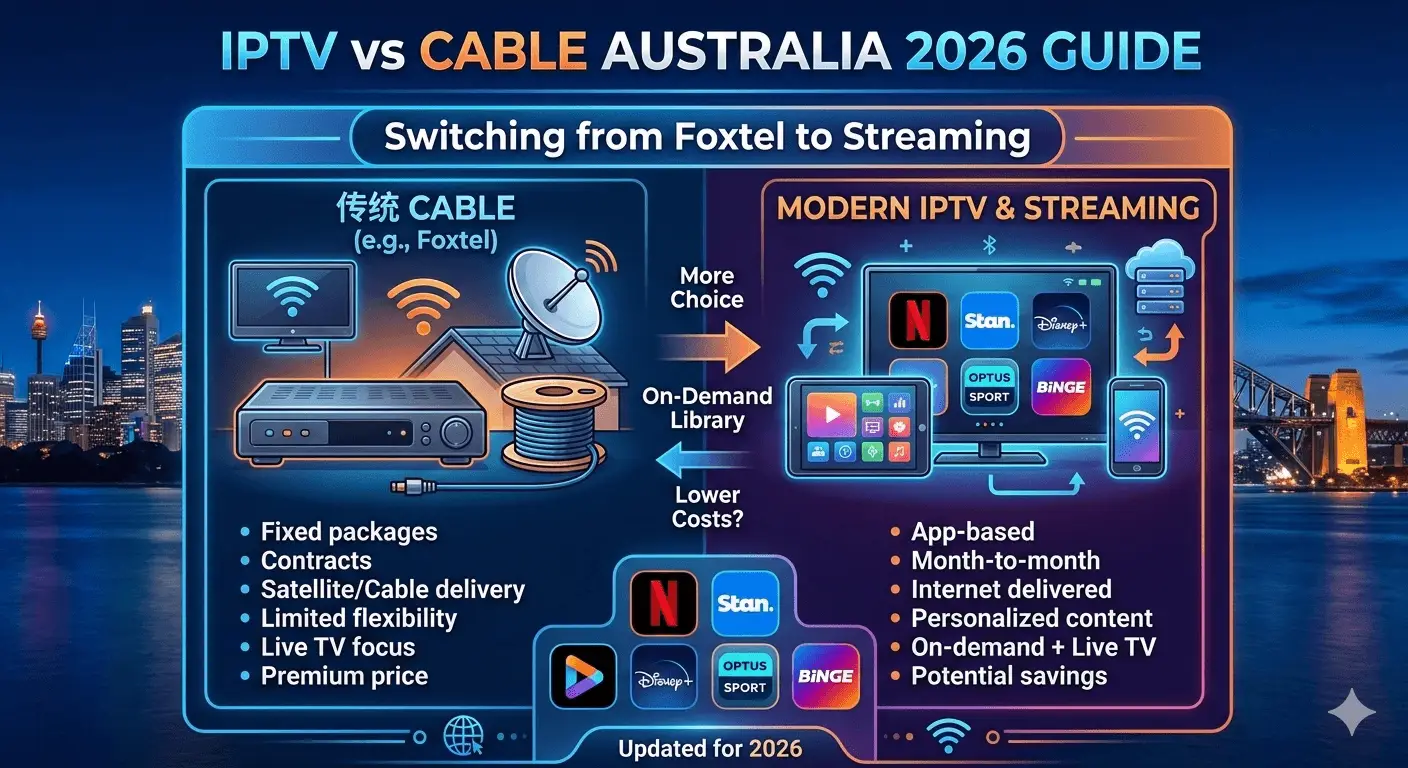
The Death of the Satellite Dish? Australia's Changing Media Landscape
I've been covering Australian media and technology for fifteen years. I've watched Foxtel go from a genuine luxury product to something that increasingly feels like a bad habit — expensive, inflexible, and slowly losing the argument. The satellite dish on the roof of the family home used to be a status symbol. In 2026, it's more likely to be an embarrassing reminder of how much money you've been throwing away.
The numbers tell the story plainly. Foxtel peaked at around 3 million subscribers in the early 2010s. Today that number has declined significantly, with hundreds of thousands of Australians cancelling every year. And the people leaving aren't just tech-savvy early adopters anymore — it's grandparents in Queensland, tradies in Western Australia, families in suburban Melbourne who've simply done the maths and decided enough is enough.
What's driving this? Three things, really. First, the NBN — which, for all its troubled rollout history, has genuinely matured into an infrastructure that can support high-quality video streaming for most Australian households. Second, the explosion of IPTV vs Cable Australia alternatives that have quietly gotten very, very good. Third, and most importantly: the realisation that the footy, the cricket, and the NRL — the content that kept so many Australians tied to their Foxtel subscriptions — is now available via Best IPTV 2026 services at a fraction of the cost.
I made the switch myself two years ago. I won't pretend there wasn't a moment of anxiety about whether I'd miss a game, or whether the stream would die in the final quarter. That anxiety lasted about a week. It hasn't been justified since. This piece is my honest assessment of where things stand in 2026 — what IPTV does better than cable, where cable still has a technical argument, and whether this is finally the year for the average Aussie household to make the move for good.
This is a direct comparison of IPTV vs Cable Australia in 2026 — the technology, the cost, the sports coverage, and the practical reality of making the switch. If you want a detailed breakdown of the best IPTV services specifically, the Ultimate Guide to IPTV in Australia is the place to start.
IPTV vs. Cable: The Technical Breakdown

How IPTV and traditional cable/satellite infrastructure compare in Australia's 2026 media market.
Let me explain how these two technologies actually work, because it matters for understanding the trade-offs. Traditional cable or satellite TV — think Foxtel — works by broadcasting a signal either through a physical coaxial cable or from a satellite in geostationary orbit 36,000 kilometres above Earth. Your decoder box receives that signal and translates it into the picture on your screen. It's a one-way broadcast: the same signal goes to every subscriber simultaneously, whether they're watching or not.
IPTV — Internet Protocol Television — works completely differently. Your content is delivered as data packets over your internet connection, on demand, point-to-point from a server directly to your device. This is the same fundamental architecture as Netflix, YouTube, and every other streaming service you use. The difference is that IPTV is specifically designed to deliver live television channels — real-time broadcasts with the low latency required for live sport — rather than just pre-recorded content from a library.
So what does that actually mean in practice? A few things. IPTV is inherently more flexible — the channel list can be updated instantly, new content can be added without any hardware changes, and the service works on literally any internet-connected device. Cable and satellite require physical infrastructure: if your decoder breaks, you need a new one; if you move house, you may need a reinstall; if Foxtel decides to remove a channel from your package, your hardware is stuck with whatever they give you.
In areas with very poor internet connectivity — think remote rural properties on slow FTTN or fixed wireless — satellite TV still has a genuine technical advantage. If your NBN connection struggles to reliably hit 25 Mbps, a satellite broadcast signal is simply more consistent. But for the 85%+ of Australian households on NBN 50 or better, this caveat doesn't apply. Check your current speeds at Speedtest.net before deciding.
The other common concern is reliability during outages. Cable TV typically keeps working even when your internet is down. IPTV doesn't — if your connection drops, so does your stream. In practice, for households with a stable NBN or 5G connection, outages are rare and brief. But it's worth having a backup plan (mobile data hotspot) for the big moments: the AFL Grand Final, State of Origin, a close Ashes Test.
Cost Comparison: How Much Can an Aussie Family Save in 2026?
This is the section most people skip to, and fair dinkum, it's the most compelling argument for switching. Let me lay out the real numbers without any spin. I've priced up a representative Foxtel package that would give you live AFL, NRL, cricket, and a reasonable entertainment selection — the kind of setup most sports-loving Australian families would want.
Foxtel's "Sport + Entertainment" bundle sits at around $85–$115 per month depending on your negotiated rate and whether you're on a contract. Add iQ5 hardware hire ($10/month), and a realistic annual bill lands somewhere between $1,140 and $1,500. The contract is typically 12 months minimum, meaning if you decide you don't want it anymore, you're paying exit fees. Installation can add $100–$200 if you're a new customer. And none of this counts the times Foxtel has quietly moved channels to higher tiers to extract more money from loyal subscribers.
| What You're Comparing | IPTV Australia | Foxtel (Cable/Sat) |
|---|---|---|
| Monthly Cost | From $19/mo WINNER | $85–$115/mo |
| Annual Cost (estimate) | ~$228/yr | ~$1,200–$1,500/yr |
| Lock-in Contract | ✔ None — month to month | ✗ 12-month minimum |
| Installation Fee | ✔ Zero | ✗ Up to $200 |
| Hardware Cost | ✔ Use devices you own | ✗ $10/mo iQ5 hire |
| AFL & NRL Live | ✔ Full coverage in 4K | ✔ Full coverage |
| 4K HDR Streaming | ✔ Included | ◑ Selected content only |
| Simultaneous Screens | ✔ Up to 5 | ✗ 1 (extra cost for more) |
| Works on Mobile/Tablet | ✔ All devices | ◑ Foxtel Go app (limited) |
| Cancel Anytime | ✔ Yes, instantly | ✗ Exit fees may apply |
| Free Trial | ✔ 48 hours, no card | ✗ No trial offered |
The savings are extraordinary. An average family switching from a full Foxtel sports package to IPTV Australia's plans would save somewhere between $900 and $1,250 per year. That's a return flight to Bali. That's a new TV. That's the kind of money that makes the decision feel genuinely significant, not just a marginal improvement.
And this is before you factor in the hidden costs of cable that people rarely think about. The technician call-out fees when hardware fails. The "loyalty tax" that Foxtel charges long-term customers who don't negotiate each year. The price creep of $5 here and $8 there as channels shift between packages. IPTV pricing is transparent, flat, and doesn't play those games.
Sports Coverage: Why Footy Fans Are Leading the Charge
I want to address this directly because it's the argument Foxtel has always fallen back on: "Yes, but you can't get the footy anywhere else." That was true for a long time. In 2026, it's simply not accurate anymore.
The best Best IPTV 2026 services carry every AFL game from Round 1 through to the Grand Final, every NRL match including State of Origin, all Test cricket and Big Bash, Super Rugby Pacific, A-League, and more international sport than most people have time to watch. The AFL and NRL have both expanded their broadcast rights in ways that now make comprehensive coverage available outside of the Foxtel monopoly — and IPTV services have been quick to pick that up.

Streaming Sports Australia in 4K via IPTV — AFL, NRL, and Cricket without the Foxtel bill.
What's actually changed isn't just availability — it's quality. I watched the 2025 AFL Grand Final through IPTV Australia and the experience was, without exaggeration, better than watching it through a Foxtel iQ5 box. The stream was stable throughout, the picture was genuinely 4K HDR (not just labelled as 4K), and the audio was clean. The stream delay was under two seconds — close enough to broadcast that you won't notice unless you're side-by-side comparing with a satellite feed.
The catch-up feature is the one that's converted the most die-hard cable holdouts I know. Miss the first half of the NRL because you're stuck at work? Rewind and watch from the beginning, or jump to any point. Time-shift a Friday night game to watch after the kids are in bed. These are features that live television — whether cable or satellite — has never been able to offer in a user-friendly way. IPTV makes them standard.
Not every IPTV service carries every Australian sports channel with equal reliability. Before you cancel Foxtel, grab a free trial and specifically test the channels you actually watch — your team's AFL channel, the NRL stream, your preferred cricket broadcast. Confirm they work on your connection before you make any cancellations.
For the NRL specifically, the coverage through quality IPTV services now rivals what you'd get through a Foxtel subscription. Every game, every round, State of Origin broadcast in full. For Streaming Sports Australia fans who've been clinging to their cable subscription purely for sport, 2026 is genuinely the year the alternative became good enough that holding on no longer makes financial sense.
The NBN & 5G Factor: Why Your Internet Is Finally Ready
For years, the honest answer to "should I switch to IPTV?" was "it depends on your internet connection." Too many Australians were on FTTN NBN connections that would max out at 40–50 Mbps on a good day, with congestion during peak evening hours dropping that to half. Streaming 4K on that kind of connection was a frustrating experience. That gave cable TV a genuine practical advantage.
That argument has eroded significantly in 2026. The NBN's FTTP upgrade programme — bringing fibre physically into homes rather than just to the node down the street — has now reached the majority of fixed-line premises. FTTP connections routinely deliver 100–500 Mbps with the kind of stability that makes 4K streaming genuinely effortless. And for areas not yet on FTTP, 5G home broadband from Telstra, Optus, and TPG has emerged as a real alternative — often delivering 100–300 Mbps with excellent reliability.
The NBN's own performance data, which you can track through independent testing at sites like Speedtest.net, shows median evening speeds on NBN 100 FTTP plans now consistently above 85 Mbps — more than enough for a household running two or three simultaneous 4K streams. The congestion problem that plagued the NBN in 2020–2022 has been largely addressed through infrastructure investment and the shift away from the more congested FTTN technology.
What does this mean practically? If you're on NBN 50 or better — which covers the vast majority of Australian households in 2026 — your internet connection is no longer the limiting factor. The thing that matters now is choosing a quality IPTV provider that has Australian-hosted servers, so the data doesn't have to travel any further than it needs to. Latency from an Australian server to an east coast home is 5–15ms. Latency from an overseas server is 150–250ms. That difference is the gap between a smooth, live-feeling sports stream and one that feels slightly detached from reality.
Not sure what speeds you're actually getting? Run a test at Speedtest.net during peak hours (7–10pm) rather than at 2pm — that's when NBN congestion is most likely to show up. If you're consistently hitting 40 Mbps or above during peak hours, you're well-positioned for 4K IPTV streaming.
Convenience & Flexibility: No Contracts, No Installation Fees
This is the section I wish someone had spelled out for me before I spent years renewing my Foxtel subscription out of inertia. The practical inconvenience of cable TV is something you stop noticing after a while — until you're on the other side of it and you realise how genuinely different the experience is.
With Foxtel, signing up involves a technician visit (which requires being home), hardware installation, a contract commitment, and the vague dread of knowing that cancelling will involve a phone call to a retention team designed to make you feel guilty about leaving. Moving house? Another technician visit. Hardware problem? You're waiting for a Foxtel support call to navigate. The friction is everywhere, and most of it is deliberate — it exists to stop you leaving.
IPTV works the other way around entirely. You sign up online in five minutes. You download an app on the device you already own. You log in. You're watching. If you move house, your subscription comes with you — same account, same channels, same experience, no matter where you are or what internet connection you're on. If you decide it's not for you, you cancel with a click. No phone calls, no exit fees, no guilt.
The multi-device flexibility is another thing people don't fully appreciate until they have it. A single IPTV subscription typically supports 4–6 simultaneous streams — meaning everyone in the house can watch something different at the same time, on their own devices, with no additional cost. With Foxtel, getting a second room set up involves additional hardware and additional monthly fees. With IPTV, it's just… included.
Switching to IPTV doesn't mean giving anything up that matters. You keep all your sport, all your entertainment, your ability to watch on any device, and your freedom to cancel whenever you like. What you lose is the bill, the contract, and the satellite dish. Most people find that's a trade they're very happy to make. Start with a free trial and see for yourself.
Essential Equipment for a Smooth Transition
One of the most common questions I get is: "What do I actually need to buy to make this work?" The honest answer is: probably less than you think. Most Australians already own at least one device that works perfectly with IPTV. But here's a clear rundown of the options, from using what you have to building the ideal setup.
My personal recommendation for most Australians: if you have a Smart TV from 2020 or later, start there. Download the IPTV app, follow the Setup Guide, and test it during your free trial. If your TV is older, pick up a Fire Stick 4K Max — at $80 it's the best value-for-money streaming upgrade you can make. If you're serious about picture quality and have a great TV, the Apple TV 4K is genuinely excellent.
Frequently Asked Questions
Yes — the technology is completely legal. IPTV is just a method of delivering video over the internet, the same as Netflix or Stan. What determines legality is whether the provider holds the appropriate content licences. The ACMA oversees broadcast licensing in Australia, and reputable providers operate transparently within the law. If a service has a real business address, published pricing, and transparent operations, it's operating legitimately. Services that are suspiciously cheap, have no contact details, and can't explain how they licence their content are the ones to avoid.
No — not with a quality IPTV service. The best providers carry all AFL home-and-away games, Finals, and the Grand Final, plus every NRL game including State of Origin. That said, the coverage available varies between providers, so the most important thing you can do before cancelling Foxtel is test your specific sport channels during a free trial. IPTV Australia's free trial gives you 48 hours with no credit card to verify exactly what's available on your connection.
If your internet drops, so does your stream — that's the main practical trade-off versus satellite TV. In reality, on a stable NBN or 5G connection, outages are rare and usually brief (under a minute). For genuinely important events like the AFL Grand Final or State of Origin, I keep mobile data available as a hotspot backup. It's a sensible precaution but one I've only needed to use once in two years of IPTV streaming. The risk is real but very low for most households on modern NBN plans.
Kayo Sports and Foxtel Now are Australian-specific streaming services from News Corp — they're legitimately licensed and have good sports coverage, but they're not the same as IPTV. Kayo starts at $25/month for sport only, with no live news, no international channels, and a limited entertainment selection. A full IPTV service gives you live channels from dozens of countries, a huge VOD library, news, entertainment, and sport — typically for a similar or lower monthly price. They solve the same sports coverage problem but IPTV gives you considerably more for your money overall.
Yes — most quality IPTV subscriptions allow 4–6 simultaneous streams on a single account. This is one of the areas where IPTV genuinely beats cable hands down. With Foxtel, each TV requires its own decoder box and typically an additional monthly fee. With IPTV, you just download the app on each device, log in with the same credentials, and watch different things simultaneously at no extra cost. For a busy household with multiple TVs, tablets, and phones all wanting different content, this is a significant practical advantage.
For a single HD stream, 10 Mbps is the minimum. For 4K, you want at least 25 Mbps with headroom — so NBN 50 or better in practice. If you're running multiple simultaneous 4K streams across a household (which is common with a family), NBN 100 is where you stop worrying about it. The other factor that matters as much as speed is stability — a 50 Mbps connection that drops to 15 Mbps during peak hours is worse for live streaming than a consistent 30 Mbps. Run a peak-hour speed test at Speedtest.net to see what you're actually getting when it matters.
The practical advice: don't cancel Foxtel until you've tested your IPTV service thoroughly and are confident it covers everything you need. Run your IPTV trial for the full 48 hours and watch at least one live sport event to check quality and stability. Once you're confident, call Foxtel directly (their cancellation line is 1300 660 750) — you'll go through a retention team, so be clear and firm. Check your contract end date to avoid exit fees, or weigh the exit fee against the monthly savings. For most people, even paying an exit fee, the break-even point is within a month or two of switching.
On a good connection with a quality provider, yes — and often better. Foxtel's 4K offering has historically been limited to a subset of content, and the bitrate on standard HD channels is lower than most people realise. IPTV services like IPTV Australia stream genuine 4K HDR on sports and entertainment content, and the bitrates are often higher than what you'd get through a compressed satellite signal. The one caveat is that IPTV picture quality is more dependent on your internet connection than satellite TV — if your connection is congested, quality can drop. On a stable NBN 50+ connection, you won't notice any difference, and on good FTTP connections the IPTV experience is demonstrably sharper.
Final Verdict: Should You Cut the Cord in 2026?

2026 is the year the case for sticking with traditional cable TV finally runs out of arguments.
After fifteen years covering this industry, I'll give you my honest conclusion: for the overwhelming majority of Australian households, 2026 is the year to switch. The technology has matured, the NBN has finally delivered on its original promise for most homes, the sports coverage is comprehensive, and the price difference is simply too large to keep ignoring.
The case for staying with Foxtel in 2026 comes down to one specific scenario: you're in a rural area with poor internet that can't reliably deliver 25+ Mbps, or you have a very specific combination of niche channels that your IPTV service of choice doesn't carry. For everyone else — which is most of Australia — the argument for cable is effectively gone.
The saving of $900–$1,200 per year is real and significant. The flexibility of month-to-month, multi-device, no-installation streaming is genuinely better. The sports coverage is there. The picture quality matches or exceeds what cable delivers. The only thing left to do is actually make the move — and the best way to do that is to start with a free trial and see it for yourself.
My recommendation: sign up for the IPTV Australia free trial today — 48 hours, no credit card, no obligation. Watch a live AFL or NRL game if one's on. Test the channels your household actually uses. Check the quality on your TV. If it works well — and it almost certainly will — call Foxtel the next day. You'll wonder why you waited this long. Check the Pricing Plans for the right tier, and the Setup Guide to get going in minutes.
Ready to Switch? Stop Paying Too Much.
Join millions of Australians who've already ditched Foxtel. AFL, NRL & Cricket in 4K from $19/mo.
No contract. No installation. Cancel anytime.
✓ No credit card ✓ Cancel anytime ✓ 48-hour trial ✓ All Aussie sports
Try IPTV Australia
Completely Free
No credit card. No lock-in. Cancel anytime.
Stream AFL, NRL & Cricket in 4K today.