Is IPTV Illegal in Australia?
Everything You Need to Know for 2026
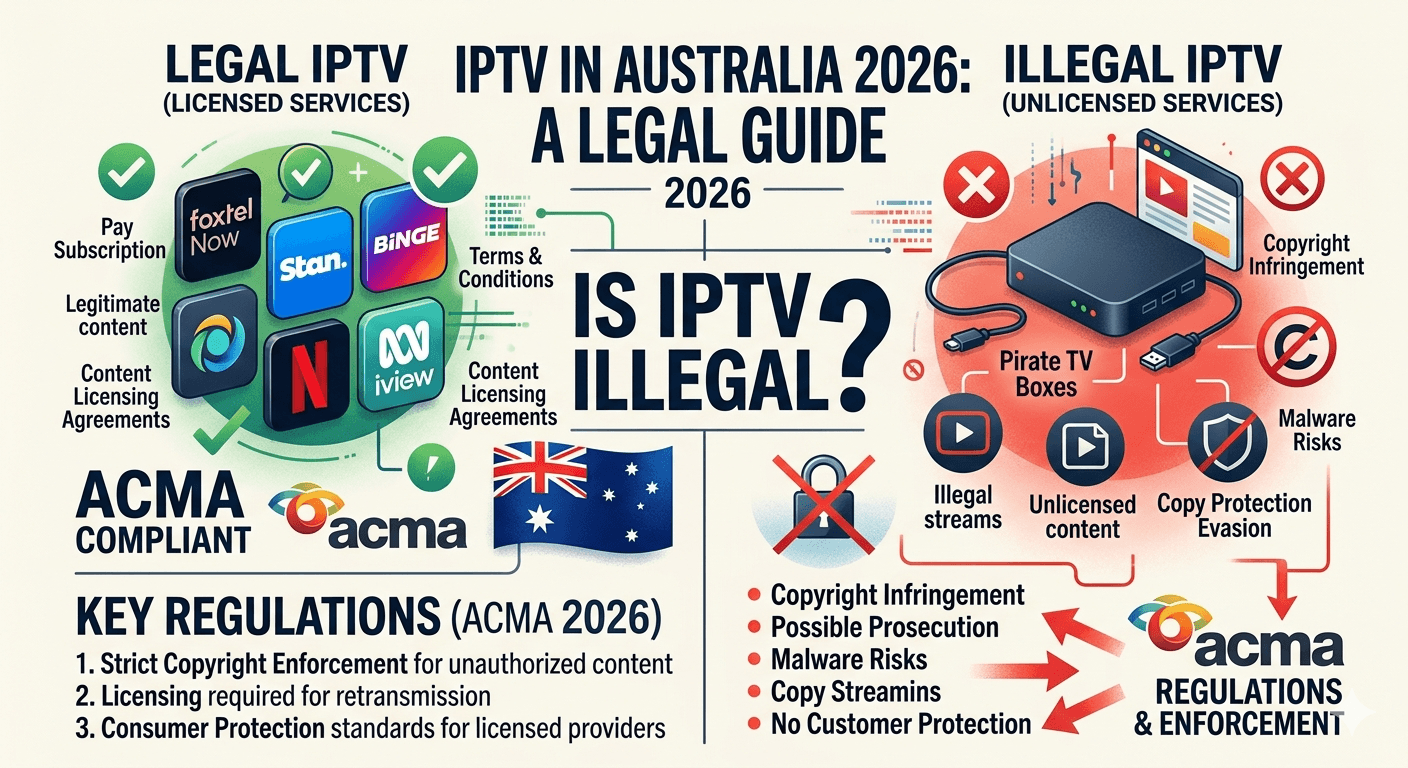
Every week in my inbox, I get some version of the same question: "Is IPTV legal in Australia? My mate uses it for the footy but I don't want to get in trouble." I've been advising on digital broadcasting law and cybersecurity in Melbourne for fifteen years, and I can tell you that the confusion around this topic is almost entirely the product of bad information — half of it from Foxtel's marketing department, and the other half from well-meaning but legally illiterate internet forums. Let me clear the air properly.
The short answer is: IPTV itself is not illegal in Australia. At all. What matters — legally, practically, and ethically — is not the technology but the service delivering it, and whether that service holds the appropriate content licences. This is a nuance that gets completely lost in most discussions, and it's the entire point of this guide.
Clearing the Confusion: What Exactly is IPTV?
Let's start at the beginning, because this is where most of the confusion originates. IPTV stands for Internet Protocol Television. In plain English: it's a method of delivering video content over the internet rather than through a traditional broadcast signal (antenna), cable connection, or satellite dish. That is the entire technical definition. There is nothing inherently legal or illegal about the protocol itself — it's just a delivery mechanism, exactly like HTTP is a delivery mechanism for websites.
When you watch Netflix, you are watching IPTV. When you use Stan, Disney+, Apple TV+, or Kayo Sports, you are watching IPTV. When the ABC streams its news broadcast live on ABC iView, that is IPTV. Every major streaming service in operation in 2026 is, technically speaking, an IPTV service. The technology is completely ubiquitous, deeply mainstream, and entirely uncontroversial in its base form.
The confusion arises because the word "IPTV" has been conflated — both in public discourse and in some media coverage — with pirate streaming services that deliver content without holding the necessary broadcast licences. These services do exist, they are illegal under Australian copyright law, and they create genuine problems. But calling them "IPTV services" is like calling bank robbery a "car crime" because the perpetrators used a vehicle. The technology is incidental. The legal issue is the content licence — or the absence of one. For a comprehensive breakdown of how the technology actually works, the ultimate guide to what is IPTV covers every aspect in plain English.
The Legal Landscape in 2026: ACMA and Australian Copyright Law

Australia's digital broadcasting regulations are overseen by ACMA — the Australian Communications and Media Authority.
Here's the real deal on Australian law. The legal framework governing streaming content in Australia sits across two main bodies of legislation, both of which have been updated in recent years to specifically address the digital streaming environment.
The Copyright Act 1968 (Cth) — The Primary Legal Framework
Australia's Copyright Act 1968 is the primary legislation governing how content can be distributed and accessed. Under this Act, broadcasting and distributing content — including via internet streaming — requires the holder of the content copyright to have authorised that distribution. Distributing content without this authorisation constitutes copyright infringement.
Critically, the Copyright Act's liability provisions are targeted primarily at distributors — the parties operating a service that streams unlicensed content — rather than individual end-users watching the stream. The distinction between distributor liability and consumer liability is significant, and it shapes how Australian law enforcement has actually operated in practice. Consumer-level prosecutions for watching an unlicensed stream are extremely rare and have not been a priority of enforcement agencies.
The ACMA and Website-Blocking Powers
The Australian Communications and Media Authority (ACMA) is the federal regulator responsible for broadcast communications in Australia. Under the Broadcasting Services Act 1992, ACMA has powers to investigate complaints about online content and refer matters for enforcement action.
More practically relevant in 2026 are the anti-piracy site-blocking laws introduced through amendments to the Copyright Act (Schedule 1 of the Copyright Amendment (Online Infringement) Act 2015, updated in subsequent years). These powers allow copyright holders — the major studios, sporting organisations, and broadcasters — to apply to the Federal Court for orders requiring Australian ISPs to block access to websites and services that are found to be primarily involved in facilitating copyright infringement.
This is the mechanism through which hundreds of streaming sites and servers have been blocked in Australia. The blocks target the operators of infringing services, not consumers. ISPs are required to implement the blocks, but individual users are not subject to penalties for attempting to access blocked sites or for having used them before they were blocked.
Under current IPTV Laws Australia 2026, the distribution of unlicensed streaming content is the primary legal offence. Operating or selling access to an unlicensed IPTV service is a serious copyright violation that can attract civil liability and, in commercial-scale cases, criminal prosecution.
Consumers watching unlicensed streams occupy a legally different position. While technically accessing unlicensed content may constitute infringement, ACMA's enforcement focus and the Federal Court's blocking regime targets operators, not viewers. This distinction is important — it doesn't make watching unlicensed content legal, but it accurately reflects where enforcement action actually occurs.
Note: This information is general in nature and not legal advice. For specific legal advice regarding your situation, consult a qualified Australian intellectual property lawyer.
The Department of Infrastructure's Online Safety and Piracy Framework
The Department of Infrastructure, Transport, Regional Development, Communications and the Arts continues to refine Australia's approach to online copyright protection. The 2026 framework emphasises rights-holder enforcement through the Federal Court blocking regime and industry cooperation, rather than consumer-level prosecution — consistent with the approach taken in comparable jurisdictions including the UK, EU, and Canada.
The NRL, AFL, Cricket Australia, and major international broadcasters have been active in using these powers, resulting in blocking orders against numerous IPTV services and proxy sites. This is why service availability can change — a service that works today may be blocked by court order next week if a rights holder has applied for and received a blocking order against it.
Verified vs. Unverified IPTV Services: Where is the Line Drawn?
This is the practical heart of the matter. Here's how to think about the spectrum of IPTV services available to Australian consumers in 2026, from clearly legal to clearly problematic.
| Criteria | ✅ Verified IPTV Service | ⚠️ Unverified IPTV Service |
|---|---|---|
| Content Licensing | ✔ Holds valid broadcast licences for distributed content | ✗ No verifiable licensing — content source unclear |
| Business Transparency | ✔ Registered business, published ABN, real contact details | ✗ Anonymous operators, no company registration |
| Payment Processing | ✔ Legitimate payment gateways (Stripe, PayPal, etc.) | ✗ Crypto only, unusual payment methods, no receipts |
| Privacy Policy / T&Cs | ✔ Published, legally compliant privacy policy | ✗ No privacy policy or vague data handling terms |
| Customer Support | ✔ Real support channels, responsive Australian team | ✗ Untraceable support, no refund process |
| Content Availability | ✔ Stable, consistent channel lineup with uptime guarantees | ✗ Channels disappear unpredictably, especially after blocking orders |
| Data Security | ✔ Encrypted data handling, secure login credentials | ✗ Unknown data practices — credentials potentially harvested |
| Free Trial Offered | ✔ Legitimate free trial, no card required | ◑ May offer trials but billing practices unclear |
| ISP Block Risk | ✔ Not subject to site blocking orders | ✗ High risk of being blocked by Federal Court order |
| Consumer Legal Risk | ✔ No legal exposure for subscribers | ◑ Technically infringes copyright; enforcement risk low but non-zero |
| Examples | Netflix, Stan, Kayo, IPTV Australia, Disney+, iView | Anonymous grey-market services with no business identity |
The practical takeaway: when evaluating any IPTV service, the questions that matter legally are about transparency and accountability, not price. A service with a published ABN, a real privacy policy, responsive support, and verifiable payment processing is operating like a legitimate business. A service that takes crypto payments, has no contact details, and whose operators are completely anonymous is operating in a way that should raise immediate concerns — both legally and from a data security perspective. For a side-by-side breakdown of how IPTV compares to traditional cable and satellite options on cost and legality, the IPTV vs Cable Australia guide goes into full detail.
Why Millions of Aussies Use IPTV Despite the Grey Areas
Let's be honest about why this conversation is happening. Australians haven't turned to IPTV services because they want to break the law. They've turned to them because the traditional pay-TV system in Australia has, for years, delivered poor value, poor flexibility, and a user experience that simply hasn't kept pace with what digital technology makes possible. If you're weighing up which service to trust, the independent review of the best IPTV providers in Australia is a good starting point.
Consider the economics. A full Foxtel Sport and Entertainment package — the kind that gives you AFL, NRL, cricket, and a reasonable entertainment selection — costs $85–$118 per month. That's $1,000–$1,400 annually, locked into a 12-month minimum contract. For a household already dealing with mortgage stress, energy bills, and grocery inflation, that figure is genuinely difficult to justify — particularly when the core content (live sport) is now demonstrably available at a fraction of the cost through legitimate IPTV alternatives.
The content availability argument is equally important. Australia has historically been subject to some of the most restrictive geographic content restrictions in the developed world. Programs that air simultaneously in the US and UK have routinely arrived months later in Australia — or not at all — because of the way broadcast rights were historically negotiated. The rise of global streaming platforms has largely solved this for entertainment content, but live sport continues to be carved up by licensing agreements that prioritise Foxtel's monopoly position over consumer access. NRL fans in particular have been disproportionately affected — the full picture on sports streaming options is covered in the dedicated guide to the best IPTV for NRL in Australia.
The NBN's maturation has also been a significant enabler. Australia's broadband infrastructure, whatever its troubled history, has reached the point in 2026 where the vast majority of metropolitan and suburban households can reliably stream 4K content. The technical barrier that once made satellite TV superior to internet streaming has essentially evaporated. When the technology works and the price is dramatically lower, the rational consumer decision is obvious.
Australia's media regulator and consumer advocates have repeatedly acknowledged that high content prices and poor availability drive consumers toward alternatives. ABC News and other major outlets have covered the relationship between Foxtel's pricing model and the growth of grey-market streaming extensively. The response from rights-holders has been to pursue blocking orders rather than to address the underlying pricing problem — which explains why the market for affordable IPTV alternatives continues to grow even as specific services are blocked.
The Risks of Using Unverified IPTV Services

The real risks of unverified IPTV services aren't just legal — data privacy and malware threats are equally serious concerns.
Here's where I want to be genuinely direct, because this section matters regardless of where you stand on the legal question. The risks associated with unverified IPTV services are real, concrete, and in several cases more immediately threatening to ordinary consumers than the relatively distant legal risk of copyright enforcement action.
The cybersecurity risks deserve particular emphasis in 2026 because they are immediate and personal in a way that legal risks are not. I've advised clients who discovered that their home network had been compromised through a malware-laden streaming app — not through any targeted attack, but through a piece of software they'd carelessly installed to watch television at no cost. The cost of remediation, including identity monitoring services and banking security changes, far exceeded whatever they'd saved on their subscription.
The Australian Cyber Security Centre (ACSC) specifically cautions against downloading apps from unofficial sources outside the Apple App Store or Google Play Store. Many unverified IPTV services distribute their apps as APK files via direct download links — a vector specifically targeted by malware distributors. If a streaming service cannot be found in an official app store and requires you to "enable unknown sources" to install it, exercise extreme caution.
This is a separate and distinct concern from the legal question. Even if an unverified IPTV service posed zero legal risk, the cybersecurity risks of its unofficial distribution method would warrant caution.
How to Stay Safe and Legal While Streaming in Australia
The good news is that in 2026, staying safe and legal while accessing comprehensive IPTV content in Australia doesn't require compromising on what you want to watch. Here's the practical framework I give to people who ask me about this:
- Check for a real business identity. A legitimate IPTV service will have an identifiable operator — ideally an Australian registered business with an ABN, a physical address, and published contact details. If the "About" page of a service is blank or the company is completely anonymous, that's a significant warning sign.
- Look for a published privacy policy. Under Australian Privacy Law, businesses that collect personal information are required to publish a privacy policy explaining how that data is handled. An IPTV service that asks for your email and payment details without publishing how those are handled is not complying with Australian law.
- Verify the payment method is standard. Legitimate services accept credit cards, PayPal, or similar standard payment methods with consumer protections attached. Crypto-only or prepaid voucher-only services are a strong indicator that the operator is deliberately avoiding a traceable payment trail.
- Test before you commit. A legitimate service will offer a free trial — like IPTV Australia's 48-hour free trial — without requiring a credit card. This allows you to verify the service works on your connection before any money changes hands.
- Install apps only from official stores. Download IPTV apps from the Apple App Store, Google Play Store, or the Amazon App Store on Fire TV. If a service requires you to sideload an APK from an unofficial source, treat that as a cybersecurity risk regardless of the legal question.
- Use a reputable VPN for general privacy. While not legally required for IPTV use in Australia, a VPN from a reputable provider adds a meaningful layer of privacy protection when streaming — particularly on public Wi-Fi. It also helps if your ISP is throttling streaming traffic. This is standard digital hygiene practice, not an indicator of anything suspicious.
- Check the service's uptime record and reviews. Services with verified uptime statistics and a genuine user community discussing their experience are far less likely to disappear overnight. Look for independent reviews rather than relying solely on the service's own marketing.
- Understand what you're subscribing to. Review the Pricing Plans carefully before subscribing. Know what channels are included, what the connection limits are, and what the cancellation policy is. Verified services explain these clearly upfront.
Frequently Asked Questions
For using a verified, legitimately licensed IPTV service: no, absolutely not. For using an unverified service that streams unlicensed content: the theoretical legal risk exists under copyright law, but consumer-level enforcement action in Australia has been extremely rare. ACMA's enforcement focus and the Federal Court's blocking regime both target operators and distributors — not individual viewers. That said, "rare" is not "impossible," and the legal framework does technically capture consumption of unlicensed content. The practical risk to an individual consumer is low, but the principled reason to choose a verified service is that it eliminates the risk entirely — while also protecting you from the more immediate cybersecurity threats associated with unverified services.
Yes — operating or selling access to an IPTV service that distributes content without holding valid broadcast licences is a serious copyright violation under the Copyright Act 1968. It can attract both civil liability (damages claims from rights holders) and, in cases of commercial-scale infringement, criminal prosecution. This is why the Federal Court blocking orders have been directed at operators, and why rights holders have pursued legal action against IPTV service operators rather than consumers. The ACMA has the power to refer matters for prosecution, and rights holders including the AFL, NRL, and major broadcasters have been aggressive in pursuing blocking and enforcement action against operators.
The ACMA is a broadcast regulator, not a consumer surveillance agency. Its mandate under the Broadcasting Services Act relates to licensing, content standards, and online safety — not monitoring individual streaming activity. The agency does not have a programme of monitoring individual IPTV user behaviour. ISPs are required to implement site-blocking orders when instructed by the Federal Court, but this is a passive blocking mechanism, not active monitoring of individual viewing habits. Individual users are not required to register, report, or notify any government agency about their streaming activities for legal IPTV services.
No — a VPN is not legally required to use a verified IPTV service in Australia. It's a general privacy and security tool that many Australians use for legitimate reasons: protecting their browsing data on public Wi-Fi, preventing ISP throttling of streaming traffic, and maintaining privacy from data collection. A VPN is completely legal in Australia and widely used by both business and personal users. It becomes useful for IPTV in specific technical circumstances — particularly if your ISP is throttling streaming traffic, you're experiencing CGNAT connectivity issues, or you're accessing the service from overseas. Using a VPN is not an indicator of illegal activity and is not treated as such by Australian law enforcement.
IPTV Australia operates as a transparent, identifiable business with published contact details, a real privacy policy, and standard payment processing. The service offers a free trial without requiring credit card details — a hallmark of legitimate consumer-oriented operations. It operates openly in the Australian market with an accessible support team. These are the markers of a business operating in compliance with Australian consumer law obligations. For specific questions about the service's licensing arrangements for particular content, contacting them directly through their published contact channels is the appropriate course of action.
The distinction comes down to content licensing, business transparency, and consumer law compliance. Legal Streaming Australia services hold the necessary broadcast licences from rights holders for the content they distribute. They operate as identifiable businesses with ABNs, published contact details, privacy policies, and standard consumer protections. Grey-market services operate anonymously, don't disclose how they access or licence the content they stream, and can't be held accountable under Australian Consumer Law. The practical consequences: legal services have stable, reliable infrastructure and aren't subject to Federal Court blocking orders; grey-market services can disappear overnight and carry cybersecurity risks associated with their unofficial distribution methods.
Your ISP can see the metadata of your internet traffic — the IP addresses and domains you connect to — as part of normal network operation. Under Australia's data retention laws (Telecommunications (Interception and Access) Act 1979), ISPs retain certain metadata for up to two years, accessible to law enforcement with appropriate authorisation. However, ISPs are not engaged in proactively reporting individual IPTV usage to copyright authorities, and no framework exists for them to do so as a matter of routine. For legal IPTV services, this is a non-issue entirely. For unverified services, it's worth understanding that complete anonymity is not guaranteed — but routine reporting of individual streaming activity does not currently occur.
The trajectory of Australian copyright law has been consistently toward stronger protections for rights holders, not weaker ones. The 2015 copyright amendments introduced site-blocking, and subsequent reforms have expanded those powers. The Federal Government's 2024 consultation on online copyright enforcement signalled an intent to further streamline blocking procedures and potentially introduce broader measures. Rights holders — particularly the major sporting codes — have been vocal advocates for stronger consumer-level measures. The practical implication: if you're currently using an unverified IPTV service and relying on the low probability of consumer-level enforcement, that probability may increase over time. Switching to a verified service now eliminates any future legal exposure regardless of how the legislative environment evolves.
Conclusion: The Future of Streaming in the Lucky Country

The future of legal streaming in Australia is clear — transparent, affordable IPTV services operating within the framework of Australian law.
The narrative around IPTV legality in Australia has been, for too long, dominated by two equally unhelpful extremes: Foxtel-aligned messaging that treats all IPTV alternatives as piracy, and counter-messaging that dismisses all legal concerns as corporate propaganda. Neither extreme is accurate, and neither serves Australian consumers well.
The factual position in 2026 is this: IPTV is a technology. Like all technologies, it can be used legally or illegally depending on how a service implements it. The markers of a legal, consumer-safe IPTV service are clear and identifiable — business transparency, standard payment processing, published privacy policy, legitimate free trials, and responsive support. The markers of a problematic service are equally clear — anonymity, non-standard payments, no consumer protections, and the associated cybersecurity risks.
Australia's legal framework under the Copyright Act and the ACMA's regulatory remit continues to develop in ways that prioritise blocking of infringing services over prosecution of individual consumers — but the direction of travel is toward stronger, not weaker, enforcement. The rational response to this landscape is to choose verified services that provide the content you want at a fraction of the traditional cost, without any of the legal or cybersecurity exposure associated with unverified alternatives.
The economics have never been more compelling. A verified IPTV subscription providing comprehensive sports and entertainment coverage for $19–$35 per month — compared to $1,200–$1,400 annually for a Foxtel package — represents a legitimate, legal, and rational consumer choice. The technology works. The legal framework supports it for legitimate operators. And for the first time, Australian consumers don't have to choose between affordability and legality.
Before committing to any service, use the Setup Guide to understand what's involved in getting started — or the full device-by-device how to setup IPTV in Australia guide for step-by-step instructions — review the available Pricing Plans, and take advantage of the free trial to test performance on your actual NBN connection. That's the informed, safe, and legally sound way to approach IPTV in Australia in 2026.
Stream Safely: Get Your Reliable IPTV Trial Today
Transparent, consumer-safe IPTV — no legal grey areas, no cybersecurity risks.
48-hour free trial, no credit card, cancel anytime.
✓ No credit card ✓ Cancel anytime ✓ Published privacy policy ✓ Real AU support